
The Silent Killer of Rotating Equipment: Why Your Bearings Are Failing (And How to Stop It)
Dachshund Through the Snow | Ebook
2026-06-11Urbancolia | Colecția PDF deschisă
2026-06-11The Silent Killer of Rotating Equipment: Why Your Bearings Are Failing (And How to Stop It)
If you manage a plant or maintain rotating equipment, you know the drill. Every few months, a pump starts making that tell-tale whine. Or a motor trips due to overheating. You pull it apart, and the diagnosis is always the same: Bearing failure.
According to industry studies, up to 80% of bearing failures are caused by either contamination ingress or lubricant loss. We slap on a new lip seal, button it up, and wait for the cycle to repeat.
But what if the seal itself was the problem?
Enter the Bearing Isolator. It is the most underrated upgrade in rotating machinery since the ball bearing itself.
The “Rubber Lip” Lie
For decades, we have relied on traditional rubber lip seals to protect bearings. They are cheap, familiar, and easy to find. But here is the truth: a lip seal is a consumable item with a lifespan of roughly 3,000 hours. Your bearings, however, are designed for 150,000 hours.
Do the math. That lip seal is sacrificing itself every few months. As it wears down, it does not just fail to seal—it actively damages your shaft by creating grooves. It creates friction, generates heat (robbing your motor of energy), and eventually hardens into brittle plastic that lets in water, sand, and process chemicals like a sieve.
What is a Bearing Isolator?
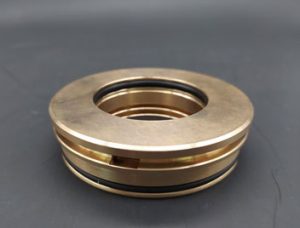
A bearing isolator is a non-contacting, permanent mechanical seal. Unlike a lip seal that rubs against the shaft, an isolator uses physics rather than friction.
It consists of two main parts: a rotor (which spins with the shaft) and a stator (which is pressed into the housing). These two pieces interlock without touching, creating a complex labyrinth path.
How does it stop leaks without touching?
The secret lies in the “Tortured Path.” As the shaft spins, centrifugal force throws lubricating oil outward. It hits a wall (a “dead end”) in the labyrinth and drops back into the sump via a return port. Simultaneously, dirt and moisture trying to enter from the outside are thrown out by centrifugal force or simply fall out via gravity through a drain slot.
The Moment of Truth: Dynamic vs. Static
This is the most important concept to understand:
-
Static Mode (Equipment OFF): When the machine stops, the bearing housing cools down. It creates a vacuum and “inhales” air. A lip seal lets it inhale dirt. A bearing isolator uses a floating ring that drops down to create a tight closure, preventing “breather ingestion” of contaminants.
-
Dynamic Mode (Equipment ON): When the machine starts, centrifugal force lifts the internal floating ring out of the way (creating a gap of thousandths of an inch). This allows the bearing to vent hot expanding gasses without spitting oil, all while the rotor runs contact-free.
Because there is no contact, there is zero wear. Zero shaft damage. Zero power loss from friction.
Real-World Results: The Case of the Rotary Feeder
Let’s look at a practical example. A food processing facility in the Midwest was struggling with rotary feeders used to meter sugar and flour. The standard packing and seals leaked material constantly. Every shift required cleanup. Worse, flour was getting into the bearings, causing catastrophic failures and shaft damage.
They switched to Air Purged Bearing Isolators. These units introduced a small amount (2-3 psi) of air into the labyrinth. The results?
-
Zero product leakage to the atmosphere.
-
Zero bearing failures since installation (running strong for over two years).
-
Elimination of daily housekeeping.
When Should You Upgrade?
You need bearing isolators if you operate in:
-
Wet environments (Washdowns, condensate, rain).
-
Dusty environments (Mining, cement, food powder).
-
High temperature areas (Ovens, kilns).
-
Critical pumps (API 610 mandates bearing isolators for process pumps).
The Bottom Line
Yes, a bearing isolator costs more upfront than a rubber lip seal—roughly ten times as much. But a lip seal is a cost; a bearing isolator is an asset.
Consider this: A bearing isolator made of bronze or PTFE lasts for the life of the equipment. It reduces energy consumption (no friction drag), eliminates shaft repairs (no grooving), and slashes unplanned downtime.
Stop changing seals every three months and start running your equipment until the next scheduled overhaul.
Have you converted your critical pumps to bearing isolators yet?